Base Layer for a Fragmenting World: ETH's Role in the Post-Trust Era
The age of verify has begun.

We are witnessing a simultaneous breakdown in global order and epistemic consensus. A collapse of shared reality is underway – communities are “locked into belief systems that can’t be challenged, where loyalty replaces evidence”. This epistemic collapse erodes institutional trust so severely that we “lose the ability to deliberate, to find common ground, to hold anyone accountable”.
At the same time, geopolitical alignments are splintering. Trade blocs realign, and the once-unquestioned dominance of the U.S. dollar is steadily waning. Russia and China now settle 92% of their bilateral trade in rubles and yuan, starkly evidencing the de-dollarization trend. Sanctioned petro-states from Iran to Venezuela have turned to crypto transactions to move commodities, routing around the Western banking system – Venezuela even accepts oil payments in USDT stablecoins, directly undermining U.S. sanctions. Global supply chains and capital flows are refactoring into parallel networks outside traditional channels, as nations and communities hedge against a fragmented future.
In short, trust – in truths, in institutions, in hegemonic money – is collapsing, and the world is reorienting toward post-trust and post-dollar realities.
Against this chaotic backdrop, one technological platform stands out as an unlikely victor: Ethereum. Through an “ultrasound” monetary policy and a credibly neutral, trustless architecture, Ethereum is emerging as the decisive infrastructure of a post-trust world. This is not the familiar Web3 hype about decentralization for its own sake. It is a sober recognition that when traditional frameworks of trust and coordination fail, verification must replace trust.
Ethereum offers exactly that: a global, leaderless base layer where code enforces honesty, value storage resists debasement, and strangers can securely cooperate without intermediation. In the sections that follow, we trace how Ethereum’s design addresses the four converging crises – truth, geopolitics, logistics, and capital – and why ETH is positioned as the monetary and coordination substrate of a fractured era.
Verification Beats Consensus Reality
Civilization runs on shared truth. Today, that common truth-framework is disintegrating. As noted by observers, “epistemic collapse” means the collapse of a shared reality due to loss of reliable truth sources. Entire publics can no longer agree on basic facts; instead, truth has become tribal, and institutions hollow. In such a world, appeals to authority or consensus are futile – there is no consensus. The implication is stark: nothing is trusted. Media, governments, scientists, even financial ledgers – all are suspect in the eyes of large segments of society.

The traditional remedy – find better authorities or fact-checkers – isn’t working, because the very notion of authority is in crisis. When “debate collapses, power doesn’t disappear, it just becomes unaccountable” , and democracy itself “isn’t under threat… it’s already gone”. We are left with a vacuum of legitimacy. Verification through transparency and cryptography offers a way to fill that vacuum. Instead of trusting institutional arbiters of truth, we shift to trusting the integrity of systems where outcomes can be independently verified by anyone. This is precisely Ethereum’s ethos: “don’t trust, verify.” Every transaction on Ethereum’s ledger is public and tamper-proof, auditable by friend and enemy alike. The network’s rules are enforced by code open for inspection, not by the reputations of bankers or bureaucrats. In a post-truth environment, such radical transparency and neutrality is not just idealism – it becomes a prerequisite for credibility.
Ethereum’s ecosystem extends this principle beyond finance into information itself. Using cryptographic oracles, Ethereum-based systems can anchor real-world data to an immutable record, creating verifiable ground truth where human institutions provide none. For example, neutral oracles can continuously record supply chain data, election results, or climate readings on-chain, acting as “objective, trustless witnesses” that cut through digital noise and misinformation. This isn’t speculative: already, blockchain oracles have been proposed or deployed to prove product provenance, verify corporate reports, and even monitor international treaties in real-time. The combination of a distributed ledger plus automated oracles can enforce a baseline of facts – a shared timeline of transactions and events that no single party (or propaganda machine) can falsify.
In a society where “loyalty replaces evidence and disagreement feels like betrayal” , Ethereum offers a way to rebuild evidence. It provides a medium where data can be universally agreed upon because verification is accessible to all, not held hostage by any faction. This flips the epistemic script: rather than trust failing institutions to tell the truth, we trust math, open source code, and globally distributed consensus. Verification becomes the new trust. Such a shift is not gentle or utopian; it is born from the failure of alternatives. But it lays the foundation for any future coordination – because without a baseline of agreed reality, social cooperation and markets collapse. Ethereum’s trustless ledger is thus more than a finance tool; it’s emerging as a bedrock of shared factuality in a post-truth world.
Geopolitical Fragmentation and De-Dollarization: Neutral Rails for a Multipolar Era
The post-Cold War dream of a unified liberal world order has given way to raw geopolitical fragmentation. We now inhabit a multipolar landscape of jostling great powers, regional blocs, and restive populaces. One casualty of this fragmentation is the U.S. dollar’s hegemony. For decades, the dollar served as the world’s unquestioned reserve currency and trade medium – a financial lingua franca underpinned by trust in American stability. That trust is evaporating.
Across the Global South, similar trends abound. Countries facing sanctions or fearing Western pressure are devising alternative settlement systems. Cryptocurrency – and Ethereum in particular – has become a financial escape hatch. By accepting stablecoins on Ethereum rails instead of dollars through banks, Venezuela sidestepped U.S. financial controls. This method echoes tactics by the so-called “Axis of Evasion” – nations like Iran, North Korea, and Russia that share cryptocurrency schemes to dodge sanctions. Russia itself, after sanctions over Ukraine, legalized crypto for cross-border trade, and soon Russian companies were receiving oil payments in Bitcoin and other cryptocurrencies from buyers in China and India. These are not niche anecdotes – they herald a structural shift. When adversary nations trade oil via Ethereum-based tokens, the petrodollar system cracks at the edges.
Even U.S. allies and neutrals are exploring dollar alternatives, unsettled by weaponization of finance and the dollar’s dilution from money-printing. The result is an emerging patchwork of bilateral currency swaps, gold settlements, central bank digital currencies, and yes, stablecoins. Paradoxically, the most widely used stablecoins are denominated in dollars – but they don’t empower U.S. control in the way traditional bank dollars do. Stablecoins on Ethereum function as dollars outside the dollar system: transferable peer-to-peer without banks, often issued by entities outside U.S. jurisdiction. They form a parallel dollar circuit that, while keeping the unit of account as USD, erodes the reach of U.S. regulators.
Stablecoins have grown into a $300+ billion asset class reaching corners of the globe the banking system didn’t. Foreign populations battered by inflation or sanctions turn to dollar stablecoins not out of love for the U.S., but out of survival instinct, accessing a stable value unit through any available rail.
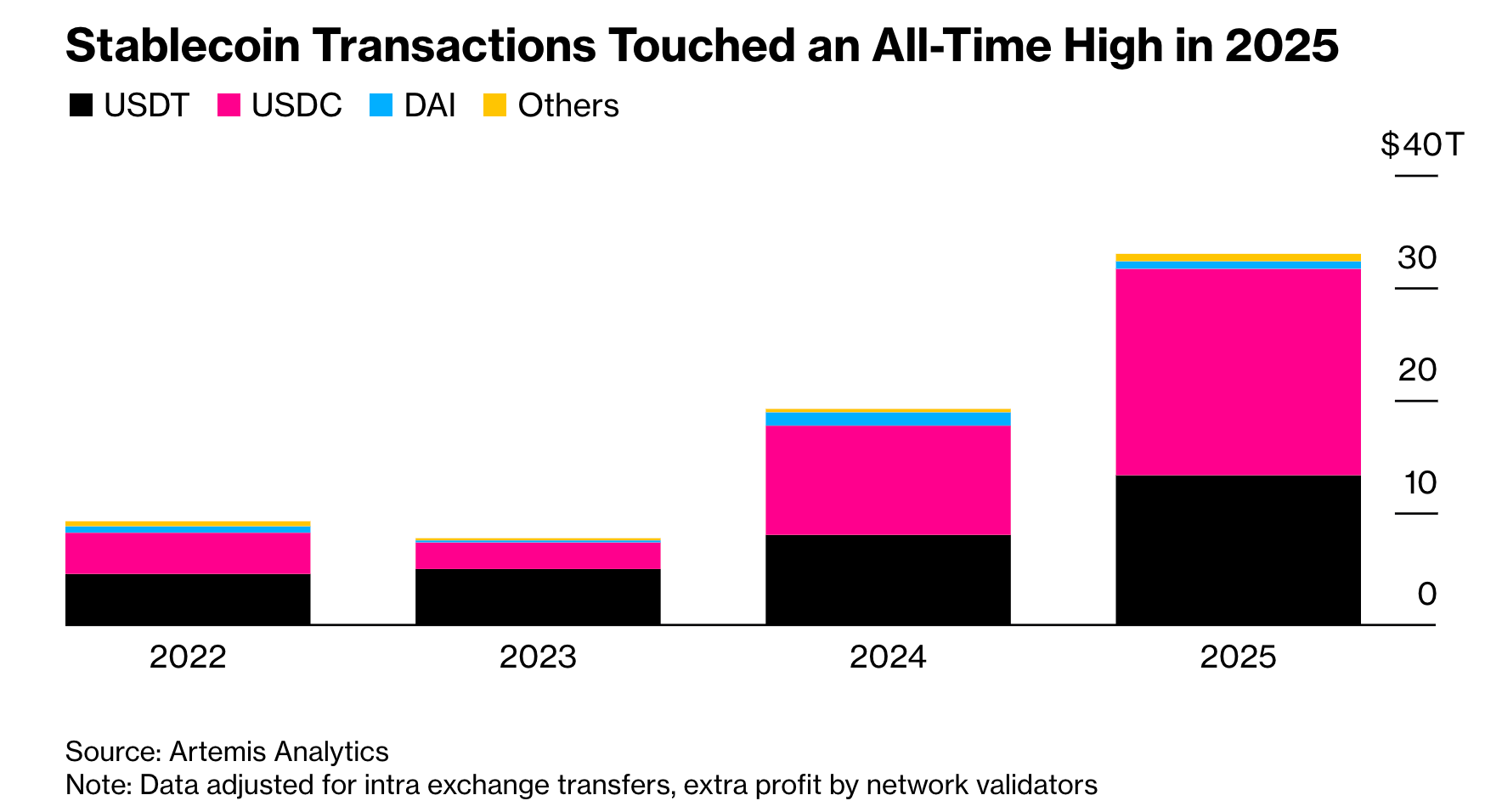
Ethereum is the primary rail for this new system. It hosts the largest stablecoins (USDT, USDC, DAI), and its network settled staggering volumes of stablecoin transactions – on the order of $33 trillion in 2025 alone. This dwarfs the payment volume of many national banking networks. And unlike SWIFT or FedWire, the Ethereum network is neutral infrastructure; it doesn’t discriminate by nationality or politics. No central authority can freeze a transaction or blacklist a country on the base layer (unless the protocol is modified by broad consensus). This neutrality is precisely what a fragmented world seeks. When no one trusts each other’s institutions, the only viable base layer is one that no one faction controls. Ethereum’s credible neutrality – a concept Buterin championed – means the protocol treats a transaction from a Syrian as equal to one from a Swiss, with no built-in bias or censorship. As long as you pay the network fee in ETH, the Ethereum base layer will include your transaction.
In a de-dollarizing world, Ethereum stands out as a stateless settlement network that can carry any currency or asset. We are seeing early glimmers of this: petrocrypto deals, sanctioned trade via stablecoins, central banks considering tokenizing reserves on public chains. These are emergent, messy responses to a strategic need: how do you trade and coordinate when you cannot trust the dominant system (the U.S. dollar network) or your rival’s system? You choose a third system that runs on verifiable rules – not on any nation’s promises. Ethereum is today the top candidate for that role. Its security is secured by thousands of independent validators worldwide, not by any single treasury or army. Its monetary policy is transparent and governed by code. And its currency, ETH, is not a claim on any state, which makes it politically antiseptic. In a multipolar environment rife with mutual suspicion, Ethereum is emerging as a kind of Switzerland of networks – except one with no Swiss bankers in charge, only open-source algorithms.
Post-Capitalist Logistics: Resilience Through Decentralized Coordination
Globalization as we knew it is fracturing. The just-in-time, hyper-optimized supply chains of late capitalism have proven brittle under geopolitical stress and pandemic disruptions. We are entering an era of “post-capitalist logistics” – not the end of commerce, but a reorganization of how goods, services, and value move when the old frameworks break. As central regimes fragment, local and transnational communities are inventing parallel systems of provisioning and exchange. Think of small farming cooperatives bypassing agribusiness, maker collectives sharing designs globally to 3D-print essentials, or informal networks coordinating disaster relief when governments fail. These micro-sovereignties and grassroots economies are experiments in resilience. Crucially, many are “experimenting with post-capitalist logistics” – proving new ownership and coordination models rather than relying on legacy supply chains, effectively inventing parallel legitimacy outside state or corporate control.
Ethereum provides a coordination substrate for these emerging networks of resilience. When trust in centralized logistics or finance is low, decentralized platforms enable strangers or distant peers to cooperate securely. For instance, a cooperative of producers and consumers spread across different countries can form a smart-contract-mediated supply chain on Ethereum: payments held in escrow, quality verified by IoT oracles posting data on-chain, and profits automatically split according to transparent rules. No single corporation or government needs to oversee it – the blockchain enforces the commitments. This is already being prototyped in projects tracking ethical sourcing of commodities, where sensors and oracles feed data to Ethereum to prove that, say, a shipment of cobalt met labor and origin standards. In a fragmented trade regime, such trustless verification of supply chains becomes invaluable. It allows trade relationships to be governed by code and data rather than diplomatic trust. A buyer in Region A and seller in Region B, who don’t even recognize each other’s governments, can still do business by relying on an Ethereum-based escrow that only releases payment when an oracle confirms delivery. This is coordination under fragmentation – enabling commerce despite political fissures.
Consider also the financial logistics of trade. Traditionally, international trade runs on credit (letters of credit, trade finance) provided by big banks with government backing. If that system erodes – say banks retreat due to sanctions risk or currency instability – Ethereum’s open financial layer can step in. Through decentralized finance protocols, liquidity from anywhere in the world can be pooled to fund commerce anywhere else, with smart contracts mitigating counterparty risk. We already see hints: small exporters in sanctioned or high-risk markets turning to crypto loans or tokenized invoices when banks won’t serve them. While nascent, it suggests an alternate capital formation system for high-risk regimes.
On Ethereum, lenders can provide capital in stablecoins or ETH to a borrower in a fragile state, with collateral and interest enforced on-chain. The lender doesn’t have to trust the borrower’s local courts – they trust that a smart contract will return funds or collateral based on preset rules.
We should note how stablecoins themselves have become a lifeline of logistical and financial resilience in unstable economies. In inflation-wracked countries like Argentina or Nigeria, people and businesses have adopted dollar stablecoins en masse as a parallel financial system for daily commerce. Over 90% of Brazilian crypto transaction volume now consists of stablecoin usage – a striking statistic that underscores how deeply these crypto dollars have penetrated real economies. Why? Because when local currencies and banks fail to provide stability, people route around them. They use the Ethereum network (or other chains) to hold and transfer value in a form more reliable than their nation’s money. This parallel system is post-capitalist in the sense that it’s not mediated by traditional capitalist banks or the state – it’s peer-to-peer, often coordinated via mobile apps and exchanges, outside the official banking system. Ethereum didn’t create the need for this; collapsing trust in fiat institutions did. But Ethereum’s infrastructure has risen to meet the need, providing a neutral highway for value when official roads are broken or gated.

Resilience through decentralization is becoming a theme for logistics broadly. Communities building local energy grids, for example, are exploring blockchain tokens to trade electricity peer-to-peer, ensuring supply even if national grids falter. NGOs are using Ethereum tokens to coordinate aid distribution in war zones where banking systems can’t be relied on. These are pragmatic responses to fragmentation: rather than hoping for a single world system to be restored, actors are developing modular, decentralized networks that can plug into Ethereum for security and settlement. Ethereum, in this context, is not merely about ideology or “crypto bros” making a buck – it is a toolkit for parallel coordination mechanisms that ensure continuity of trade and supply when conventional mechanisms fail. By leveraging Ethereum’s global accessibility and automated trust, fragmented regions can achieve a form of supply sovereignty: controlling their own trading arrangements and resource flows without needing a superpower’s infrastructure or permission.
In sum, as the logistics of the future drift away from monolithic global capitalism, Ethereum’s network is positioned as the common connective tissue. It’s the protocol through which disparate, autonomous entities – from local co-ops to dissident networks to small nation-states – can interoperate financially without a central hub. The cost is that each participant must embrace radical transparency and the discipline of code-based rules. The benefit is resilience and autonomy in an otherwise hostile and unreliable global environment.
“Ultrasound Money”?
Why Ethereum? What sets this network apart such that it could become the monetary and infrastructural base layer of a post-trust world? The answer lies in a confluence of technical and economic design choices that have reached critical mass in Ethereum.
Firstly, Ethereum from its inception was built with the explicit goal of enabling coordination without trust in intermediaries. As the Ethereum Foundation’s new Trustless Manifesto emphasizes, Ethereum wasn’t created to optimize transaction speed or to make Wall Street more efficient – it was created so that people could “coordinate without trust in intermediaries”. This DNA permeates the system’s architecture: anyone can join and verify the network’s state without permission, and no central operator is indispensable for it to function. Ethereum’s core values, now explicitly articulated, are credible neutrality, self-custody, verifiability, and resistance to convenient centralization. In practice this means the network prioritizes being open and tamper-proof above all, even if that sacrifices some efficiency or user-friendliness. In a world riddled with backdoors and choke points, Ethereum’s stubborn insistence on decentralization is looking less like an ideological quirk and more like a strategic masterstroke.
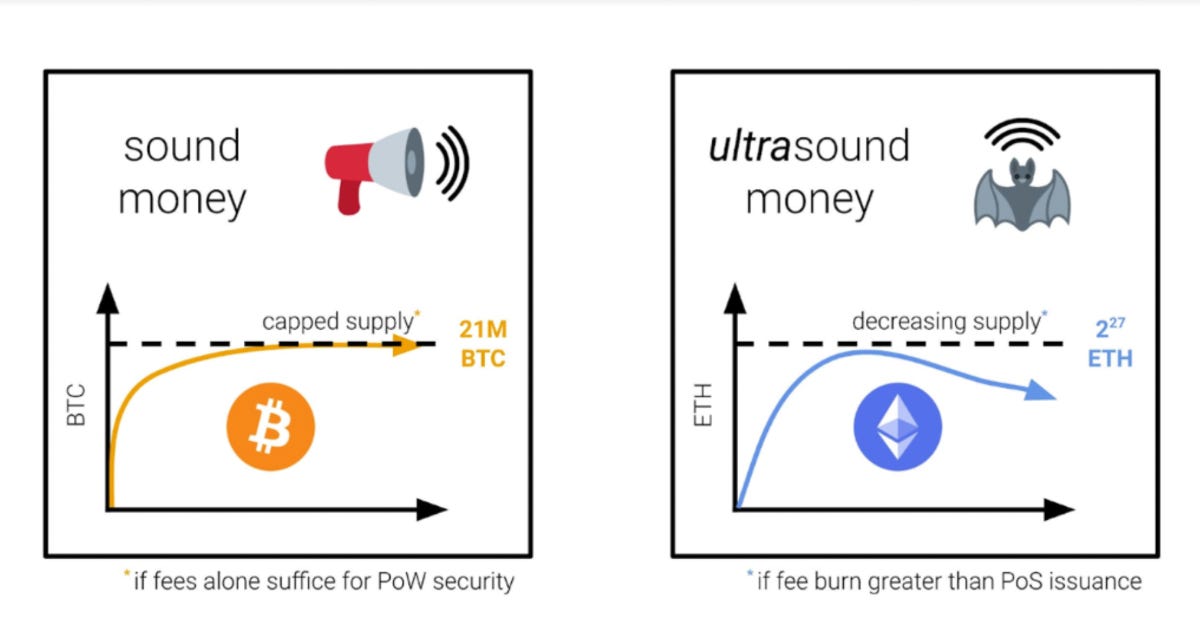
Crucially, Ethereum has achieved a level of adoption and security that makes it incredibly hard to kill or co-opt. As of 2025, the network is secured by over a million active validators distributed globally – an army of nodes so widespread that no single government or cartel can easily shut it down. Each validator verifies every block, enforcing the protocol’s consensus rules. The result is a blockchain that has survived concerted attacks, regulatory pressures, and internal wars, and kept producing blocks on time. Ethereum’s successful transition to proof-of-stake and the implementation of EIP-1559 (fee burn) also transformed its native asset, ETH, into “ultrasound money.”
This meme, coined by Ethereum researchers, means that ETH’s supply can decrease over time, especially when network usage is high Unlike Bitcoin’s fixed 21 million supply (labeled “sound money”), Ethereum introduced a burn mechanism that sometimes makes its supply net deflationary. In plain terms, ETH has, at times, become scarcer the more it is used – a powerful dynamic in a high-demand environment. Supporters call this ultrasound money to signify a store of value superior even to Bitcoin, since a shrinking supply could drive value up over the long term. Indeed, since the 2022 Merge to proof-of-stake, Ethereum’s issuance dropped drastically and periods of deflation have been observed during busy network activity. In a world where central banks are printing incessantly or where inflation and currency debasement run rampant, ETH stands out as a non-sovereign asset with a credibly low-inflation or deflationary profile.
But Ethereum’s monetary cred is only half the story – it is also programmable infrastructure. This means ETH isn’t just digital gold; it’s digital gold with an embedded global financial system on top. Anyone can spin up a new financial instrument (via smart contract) that will run exactly as coded, without requiring trust in the issuer. This property has catalyzed the explosion of decentralized finance: exchanges, lending markets, insurance, derivatives, all automated on Ethereum. For the post-trust thesis, the significance is that capital formation and exchange can occur on Ethereum without relying on Wall Street, London, or Beijing. High-risk ventures that would never get funding through conservative banks can raise capital through tokenization or DAOs on Ethereum, tapping a worldwide pool of investors who verify everything on-chain. For example, entrepreneurs in politically unstable regions have used token sales or NFT drops to crowdfund projects when domestic banks wouldn’t even open an account for them. Similarly, if two companies from different geopolitical blocs want to collaborate but neither trusts the other’s legal system, they can form a joint venture as a smart contract, hold each party’s capital in escrow in ETH or stablecoins, and programmatically enforce profit-sharing or refunds upon certain conditions. The code becomes the contract, globally enforceable on Ethereum’s impartial ledger. This is capital and coordination without trust – or more precisely, with trust placed only in open-source code and distributed consensus.
Ethereum’s neutrality also means it can serve as the settlement layer between CBDCs and national digital currencies that otherwise can’t interoperate due to politics. If every major power issues its own digital currency, we face a new Tower of Babel for value transfer. Ethereum (or an Ethereum-like public chain) is a plausible bridge where those different currencies can be exchanged or operated via smart contracts, precisely because Ethereum does not belong to any one of them. In essence, Ethereum could function as the common ledger of value that underlies a basket of fragmented digital monies, much as gold (and later the dollar) once underlay the Bretton Woods system. The difference is that Ethereum’s ledger is publicly verifiable and governed by no one’s army – only by the economic incentives of its participants. This makes it uniquely suited to be the monetary base layer when no sovereign currency can be universally trusted.
To be clear, this is a strategic and hard-nosed case for Ethereum, not a naive crypto fan pitch. The very features that make Ethereum slower or more cumbersome than centralized systems (global consensus, proof-of-stake checks, open access for all) are what make it robust under adversarial conditions. It’s the same reason the Internet was built with redundancy and decentralization – to survive nuclear-level disruptions. Ethereum’s design assumes adversarial conditions by default (“zero trust” approach), and that is exactly what our geopolitical and social climate is becoming. While competitors and copycats exist in the crypto world, Ethereum’s head start in security, developer ecosystem, and network effects gives it a formidable position. Its community has also shown a willingness to evolve (e.g., the Merge) without compromising core principles, which cannot be said for all chains. In short, Ethereum has achieved an infrastructural critical mass: it is sufficiently secure, widely adopted, and flexible to serve as the backbone for a post-trust global system.
Trade-Offs and Challenges: No Panaceas, Only Possibilities
Presenting Ethereum as the base layer of a new order is not to say it’s a flawless solution or an inevitable victor. No honest manifesto can ignore the trade-offs and risks involved. Ethereum’s trustless design comes at the cost of complexity and throughput; it deliberately processes fewer transactions per second than a centralized network to ensure every step is verifiable. This has led to high fees and scaling challenges – weaknesses that opponents or alternatives could exploit. However, layer-2 rollups and sharding upgrades are rapidly advancing to amplify capacity without sacrificing decentralization. The Ethereum roadmap explicitly prioritizes trustlessness over raw throughput, echoing the manifesto’s warning that chasing convenience via centralization “threatens Ethereum’s core principles”. If some users opt for cheap but centralized alternatives, Ethereum may lose certain use cases. But for high-stakes value and truth, the bet here is that people will ultimately demand the security of verification over the illusion of low-cost trust.
Another challenge: state resistance. If Ethereum truly emerges as critical global infrastructure, nation-states (especially incumbent powers) will not sit idly by. We already see early frictions – for example, U.S. regulators litigating against crypto exchanges, or calls to restrict stablecoins because they enable sanction evasion. As mentioned, Venezuela’s use of USDT for oil “merits a strong…policy response” according to U.S. analysts. We should expect states to try co-opting or strangling parts of the crypto ecosystem. They might promote their own “blockchains” that bake in surveillance and control, or pressure centralized stablecoin issuers and mining/staking operations within their jurisdiction. Ethereum’s resilience will depend on its decentralization – on having enough nodes, developers, and capital spread globally such that no single government’s actions can cripple it. This is why efforts to keep infrastructure decentralized (like running nodes on home hardware, or projects like Distributed Validator Technology) are not just tech fetishism but vital for geopolitical robustness. The community must remain vigilant that convenience doesn’t create chokepoints; e.g., reliance on a few cloud providers for nodes is a lurking risk. The recent example of a major Ethereum Layer-2 (Base) partly going down due to an AWS outage is a cautionary tale – true base-layer Ethereum survived fine, but it shows how easily higher layers can be tempted by centralization. The solution is continued commitment to credible neutrality and censorship-resistance, even if it means slower adoption among those who prefer Web2-like simplicity.
There is also the issue of volatility and valuation. ETH as an asset has been extremely volatile – can something so mercurial serve as the world’s base layer money? Here we must distinguish timescales. In early adoption phases, volatility is inevitable. If Ethereum’s thesis holds, over the long term ETH’s value should stabilize (paradoxically as a result of wider adoption making it the settlement token). Stablecoins on Ethereum provide a buffer in the meantime for pricing goods, but those stablecoins themselves face questions of trust (centralized collateral) or scaling. It’s possible a new class of cryptoassets (like algorithmic or commodity-backed stables, or perhaps tokenized fiat with decentralized governance) will mature to complement ETH. The key point is that Ethereum does not demand exclusive use of ETH for all purposes; it is a multi-asset platform. As trust evaporates in weaker currencies, more value will flow into either USD stablecoins or hard assets like ETH and BTC – and a significant portion of those flows already ride on Ethereum. One can envision a future where ETH is the reserve collateral (like gold) and stablecoins are the day-to-day currency, all settled and collateralized via Ethereum. This is not very different from past gold-standard eras, except it’s open to anyone with an internet connection.
Security is another concern: smart contract bugs, 51% attacks, cryptographic breakthroughs – any could be exploited to undermine the system. These risks are real, but Ethereum has shown a capacity to respond (e.g., rapid client updates during crises, bug bounties, academic audits). Its social layer – the global community of users and developers – is perhaps its ultimate line of defense. If a severe exploit occurred, the community could coordinate a fork or fix (albeit painfully). This social fallback is messy and contradicts the “code is law” mantra, but in a trustless system even the social layer is more transparent and voluntary than trust in opaque institutions. In a sense, the community’s cohesion and values (neutrality, openness) are part of Ethereum’s security model. They have held through civil wars (e.g., the DAO fork vs Ethereum Classic) and will likely be stress-tested again.
Finally, we must address the trade-off of pseudonymity vs illicit use. A post-trust world where Ethereum is the main rail may be one where bad actors also leverage it (just as they use the dollar). Critics will point out that if you remove intermediaries, you also remove checkpoints for things like money laundering or terror financing. That is true – permissionless systems treat all comers the same. The strategic counterpoint is that attempting to police everything via centralized choke points has led to widespread financial censorship, inequality in access, and the very fragility we are trying to escape. A balance of new tools (like on-chain analytics, community-driven governance, perhaps even algorithmic regulation) will need to evolve to handle crime without reinstating totalizing trust hierarchies. This is a deep topic beyond our scope, but the short answer is: Ethereum sacrifices centralized control, and with it comes both the good (resilience, inclusion) and the bad (permission for anyone, including criminals). The bet is that the net benefit to society – in enabling honest coordination and preserving liberty in the face of authoritarianism – outweighs the downsides, and that other methods of policing can be developed that don’t compromise the neutral base.
Ethereum as the Foundation of a Post-Trust Global System
The world is not neatly moving toward some liberal utopia; it is veering into a period of profound distrust, rivalry, and fragmentation. The collapse of shared truth, the splintering of financial order, and the search for new logistic networks are all symptoms of one grand theme: the old trust-based systems are crumbling. In their place, verification-based systems must arise – because human institutions no longer uniformly command belief. Ethereum, almost accidentally, finds itself at the forefront of this transition. What started as a crypto experiment to decentralize the web has matured into a robust, neutral settlement layer handling tens of billions in daily volume, hosting currencies and assets for millions of people who don’t trust their banks or governments, and running code that mediates agreements from trivial to life-changing. It has weathered attacks and adapted, all while adhering to the principle that anyone can participate with full verification and without permission.
This is the definition of a post-trust system: one where you don’t need to trust the other participants or a central referee – you only need to trust the integrity of the system’s verifiable rules. Ethereum’s greatest victory is proving that such a system can operate at global scale, securing real value and enabling complex cooperation. In doing so, it has carved out a unique strategic niche. It’s not just a currency, not just a database, but a new kind of institutional substrate – one which any faction can use but no faction can own. That makes it, in game-theory terms, a Schelling point for coordination: when no one can agree on whose infrastructure to use, they may all grudgingly agree to use the one that is neutral and transparent. We already see adversaries indirectly coordinating over Ethereum (e.g. swaps between sanctioned nation’s funds and Western counterparties via DeFi, because neither trusts the other’s banks). This is likely to increase as other forms of trust decay further.
The case for ETH as the monetary base of this new order flows naturally: a trust-minimized system needs a trust-minimized currency. Gold served this role in an earlier era, but gold cannot teleport value at the speed of the internet or run complex contingent logic. ETH can. Bitcoin, another contender, nails the trustless money aspect but lacks the rich programmability and active usage Ethereum enjoys; it has a role as digital gold, but Ethereum is positioning itself as digital oil, gold, and Swiss bank all in one, fueling an entire economy of dApps. In a fragmented world, we should expect multiple assets to coexist, but Ethereum’s network effects and flexibility give it a strong claim to being the primary settlement layer and economic bandwidth for whatever new system emerges from the ashes of the old.
None of this implies that the transition will be smooth or that Ethereum will automatically “win” by default. It means that, if the trends identified persist, Ethereum is uniquely well-suited to thrive under those conditions, and indeed is already aligning with them. The strategic imperative for the Ethereum community now is to harden the network’s decentralization, continue financial innovation at the edges (especially where it interfaces with the physical world via oracles and real assets), and uphold the principle of credible neutrality even under pressure. The world’s first post-trust infrastructure is only as valuable as its immunity to becoming just another tool of power. So far, Ethereum’s trajectory – resisting capture by governments or megacorps, even as it integrates with them at the edges – is promising.
The coming era will test all systems to their breaking points. Many legacy institutions will fail those tests. Ethereum, by virtue of being built for adversarial environments, stands a better chance than most. This manifesto does not predict a gleaming techno-libertarian paradise. It argues for Ethereum as a bastion of reliability and collaborative potential in a world where those qualities are scarce. When truth is disputed, Ethereum can record and enforce facts that everyone sees. When money is suspect, Ethereum can host forms of value that are beyond any single corrupting hand. When cooperation falls apart, Ethereum’s smart contracts can bind parties together in fair exchange. These are profound capacities.
Under adversarial scrutiny, one must ask:
What alternative offers a similar blend of neutrality, security, and global acceptance?
So far, none of the contenders (whether state-run networks, corporate consortia, or other blockchains) tick all the boxes without introducing new vectors of trust or control. Ethereum is not perfect, but it is good enough and hardened enough to be the strategic choice for a post-trust base layer. It has achieved what many thought impossible: an autonomous world-scale platform that keeps running and can’t easily be captured. In the face of fragmentation, that is an anchor to cling to.
The trade-offs are sharp, and the ethos is uncompromising: verification over trust, code over handshakes, openness over opaqueness. This ethos will not win popularity contests in tranquil times – but in turbulent times, it may be the last thing standing that actually works. Ethereum, by aligning with the trend “from trust to truth” , has placed a hard bet against the old order. As trust continues to erode, that bet looks increasingly prescient. The world’s fractures will not magically heal; we must build bridges that withstand the fracture. Ethereum is that bridge – or at least, the blueprint of how we can connect and cooperate when nothing else can be assumed reliable.